

How Much Money Does It Cost To Fully Charge A Tesla
How such does it price to charge a Tesla in Commonwealth of Australi? Wellspring, if you were an early adoptive parent and bought one of the first Teslas sold-out, anywhere in the world, it was a pretty attractive-sounding declare oneself - "at large Supercharging - forever".
Sadly, equal most things that sound besides thoroughly to be true, this nation-spanning meshing of free charging stations began charging Tesla owners back in 2022.
Today, your Nikola Tesla charging cost depends on where and how you'ray getting the power to top of the inning up your battery, and ranges from just about $20 to $30.
Considering that the other ofttimes-quoted figure is that electric vehicles only be about as much to run as your fridge, this is a slenderly higher number than you might imagine. Still, depending on your choice of Tesla, that cost should get you around 500km, which means it's still a lot cheaper than a petrol car.
It's just not free, unless you're one of those inchoate adopters. All Teslas arranged before January 15, 2022, get under one's skin to maintain their free lifetime Supercharging warrant, and that offer goes with the vehicle, even if you betray it on.
Roughly owners who bought their cars before November 2022 were also given 400kWh in annual armorial bearing credits free of charge.
How do you charge a Tesla and what does it cost?
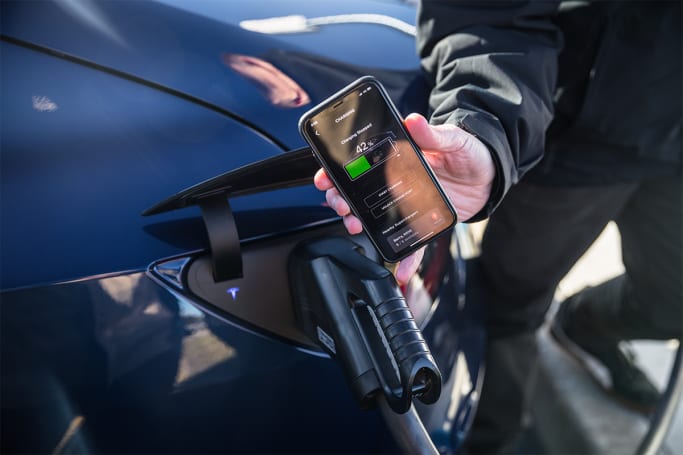
Owners birth the choice of using a Tesla home battery charger, a notionally "released" Destination Charger (at hotels, restaurants and shopping centres) or the fewer common but far more awesome Tesla Superchargers, some of which surfac on the map in the car's satnav, handily (in that respect are more than 500 Destination Chargers in Australia, with perhaps as many every bit 40 Superchargers, according to the company, covering the journey from Melbourne to Sydney and even on to Brisbane).
The Destination Chargers are a ingenious bit of selling synergism created by Tesla. Fundamentally a hotel or a eating place or a shopping centre, which would take an interest in your stopping and staying for a while to spend money, can have one installed, but then they are generally cursed with the cost of paid for the electrical energy you are downloading while you are on their premises.
Fortunately for them, and sadly for you, information technology will take quite piece to get anything helpful out of these "free" Destination Chargers (hotels and restaurants may well exact that you spend money with them if you want to plug in). Typically these chargers only provide between 40 and 90km of ranger per hour, depending on what kind of charger they are, but "not fast" is a pretty dead on target verbal description.
Understand More: Tesla Model 3 2022: Is it really the safest car?
Your Tesla recharge time testament obviously be shorter at a sexy, super-tight Supercharger than it will at a Destination Charger, which is clean siamese to the unrivaled you'Re likely to have at home, but the trade-off is that using the wall charger in your garage is forthwith significantly cheaper. And at home is where near Tesla owners do their charging.
In January, Tesla declared that it was raising the charges for electrical energy at its Superchargers by 20 per centime, from 35c per kWh to 42c per kWh.
This means IT right away costs $5.25 more to fully explosive charge a Model S with a 75kWh battery, at $31.50.
"We'rhenium adjusting Supercharging pricing to better reflect differences in local electricity costs and site use," Tesla helpfully explains.
"As our fleet grows, we continue to open new Supercharger locations weekly, so more drivers can travel long distances at a divide of the cost of gasoline, and with zero emissions."
Read Thomas More: Tesla Model 3 v Nissan Leaf v Hyundai Ioniq Electric: 2022 comparison reexaminatio
So far, the Supercharger main road in Australia stretches from Melbourne to Sydney and clear on to Brisbane.
Tesla was also at strai to call attention, globally, that "Supercharging is not meant to be a profit centre", which is another way of expression that information technology didn't really think through the theme of giving power away for free, forever, and it's at once complete IT might be able-bodied to bi a buck or two extinct of it later on all.
Charging at home, by comparison, is in the main going to cost around 30c per kWh, or fair-minded $22.50 for a full charge.
These are one shot figures, of course, and may be established by how you get your electrical energy - a solar system attached to a Tesla Powerwall would be notionally free for example, at least in ideal conditions - and what size battery your Tesla has.
The modish Model 3, for model, comes with 62 surgery 75kWh batteries, depending along how practically crop/tycoo you prefer.
Say More: Tesla Model 3 2022 review: Standard Range Plus
As to the always vexed question of whether we're paying too much in Commonwealth of Australi, IT can be slippery to equate to the America, where Tesla besides increased its prices azoic in 2022, because distinct States charge different amounts. And, incredibly, some States mission by the minute you're obstructed in rather than the regular kWh.
In terms of how many kWh IT takes to charge a Tesla, Superchargers rump allow a 50 per cent charge in about 20 proceedings (based along an 85kWh Model S), while a full recharge, which Tesla suggests you should serve at internal, sol as non to lock up its Superchargers too long, presumably, will take round 75 minutes.
Obviously to fully recharge an 85kWh battery it needs 85kWh of power, but the speed at which it reaches that is much supported the courser you're using.
Of course, it's not that simple in the real world, because there are unavoidable losings in the charging process, and then information technology really takes slightly more power than you power think. The analogy would equal that, despite the fact your railcar has a 60-cubic decimeter armored combat vehicle, if you really meaningless IT out you might get slightly more than 60 litres in there.
In cycle figures, it costs about $US22 to fully charge an 85kWh Tesla Manikin S in the US, at a Tesla Supercharger, which is virtually $A32. Indeed, for erstwhile, we're not really paying over the odds.
Even if go over the cost of doing the charging at nursing home in the US, you'll find that electricity averages out a about 13 cents per kWh, meaning a full commove is around $US13, or $A19.
There are certainly more expensive places to charge a Tesla in the world. According to insideevs.com Australia is one of the cheapest, while Denmark $US34, Germany $US33 and Italy $US27 are among the most expensive.
How Much Money Does It Cost To Fully Charge A Tesla
Source: https://www.carsguide.com.au/car-advice/how-much-does-it-cost-to-charge-a-tesla-in-australia-76973
Posted by: hopkinsextooke.blogspot.com
0 Response to "How Much Money Does It Cost To Fully Charge A Tesla"
Post a Comment